

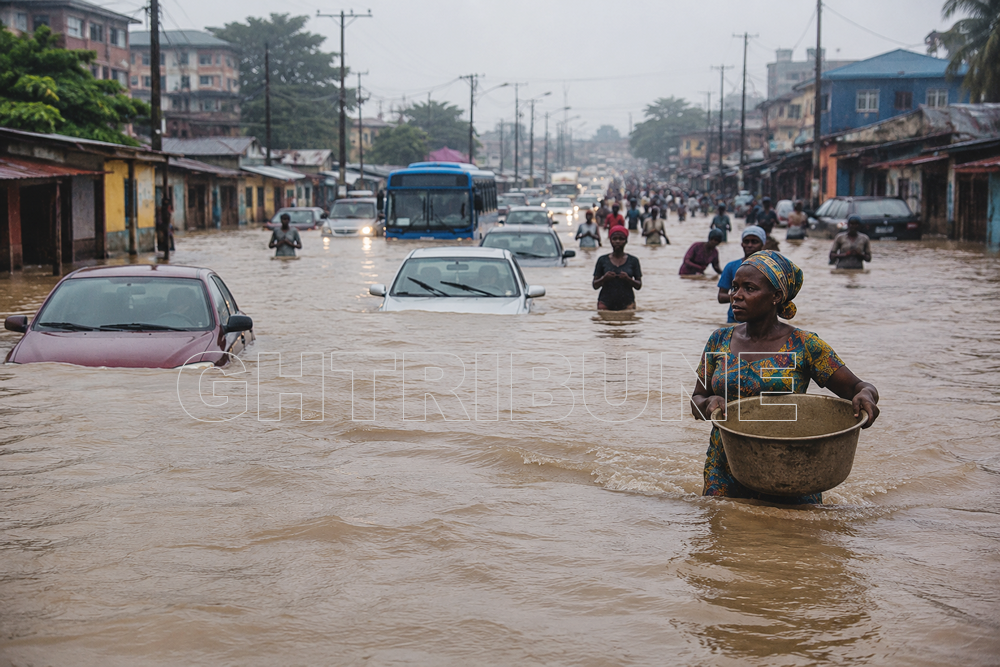
Every time heavy rains hit Accra and other urban centres, we witness the same heartbreaking scenes; homes submerged, businesses destroyed, roads cut off, vehicles swept away and, tragically, lives lost.
And almost immediately, another flood begins; not of water, but of politics.
One side blames the government in power. The other defends it. The victims are forgotten while the political arguments rage on.
But if we are honest with ourselves, Ghana's flooding problem is far older and far deeper than any government that has been in office for less than two years.
Flooding is the result of decades of accumulated failures.
It is the result of:
No government should escape scrutiny. Governments have a responsibility to plan, enforce regulations, invest in drainage systems, and protect lives.
However, it is neither accurate nor productive to suggest that a government that has been in office for less than two years single-handedly created a problem that has been decades in the making.
That kind of thinking may win political arguments, but it does not solve flooding.
We must stop treating every national disaster as an opportunity to score partisan points.
Instead, we should be asking tougher questions:
Floods do not distinguish between NPP, NDC, CPP, or independent voters.
The water enters everyone's home the same way.
The child swept away by floodwaters does not belong to one political party.
The trader who loses her life's savings in a flooded market does not care which manifesto promised better drainage.
Disasters should unite us around solutions—not divide us into political camps.
What Ghana needs is a bipartisan, long-term national flood resilience strategy that survives changes in government. Drainage projects, urban planning reforms, environmental enforcement, and public education
should become national commitments rather than campaign promises.
The rain is not political.
The flood is not political.
Our response shouldn't be political either.
Let us mourn with those who have lost loved ones, support affected families, hold leaders accountable where necessary, and demand lasting solutions instead of temporary outrage.
Because if all we do after every flood is argue about who to blame, then when the next rains come—as they surely will—we will once again be counting lives lost instead of lessons learned.
No.9 Korley Kofi Ave, East Airport - Accra
+233(0)504817488






© The GH Tribune. All Rights Reserved. UI by HTML Codex | Powered By: GH Tribune