

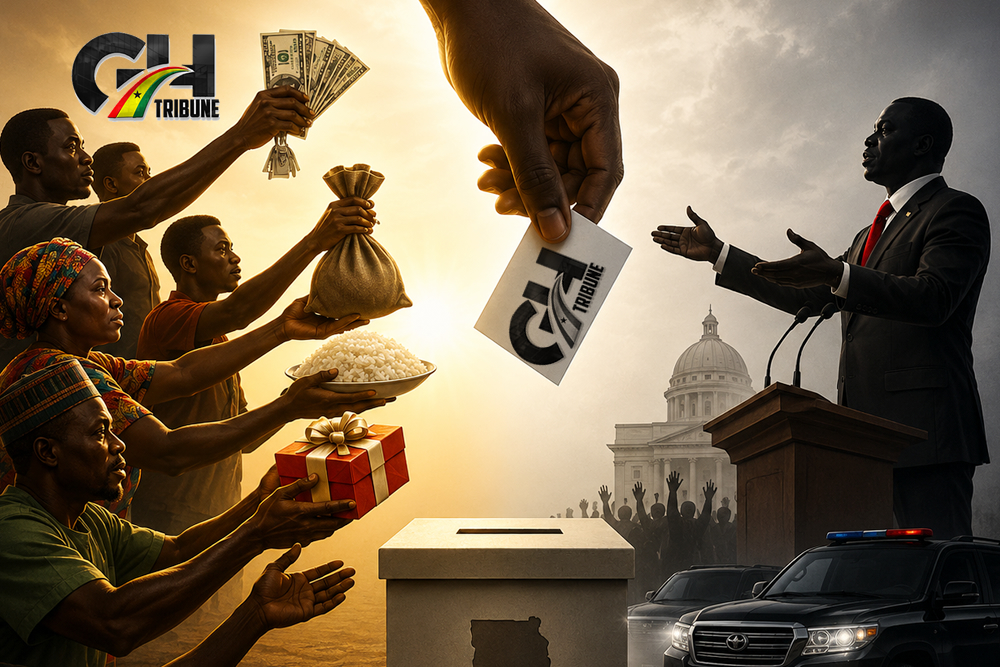
In every election season, the posters go up, the convoys roll through town, and the promises fly faster than campaign jingles. By the time voting day comes, aspirants are not just selling policies. They are answering demands: “Pay my school fees,” “Fix our road,” “Give us bags of rice,” “Support my funeral.”
If you say no, the threat is immediate: “We won’t vote for you.” “We will vote you out.”
And so the cycle begins. To “serve the nation,” candidates and sitting governments pour money out, not into systems, but into pockets, funerals, festivals, and quick-fix projects. By the end of one term, the treasury is lean, projects are abandoned, and the word on everyone’s lips is one: corruption.
But before we point fingers only at the politician in office, we have to ask a harder question: Who taught them that governance is a transaction?
1. We turned votes into commodities: A vote is supposed to be the people’s power to choose leadership, ideas, and direction. Instead, we’ve priced it. GHc50 here, a bag of cement there, a promise to “do something for the youth.” The moment a vote has a price tag, the person buying it will expect returns. And the fastest way to get returns on that investment is through contracts, kickbacks, and looting.
The politician who refuses to “share the money” often loses. The one who shares, wins. So we don’t just elect leaders. We train them.
2. We demand the impossible, then punish reality: During campaigns and even in office, the electorate makes demands no budget can meet: jobs for everyone in the constituency, money for every group, instant development. Government is not a magic bank. But saying “that’s not realistic” is political suicide.
So leaders borrow, divert, or inflate contracts to meet the pressure. They cut corners to stay in the good books of the people who put them there. In trying to survive the next election, they mortgage the nation. The corruption we cry about later was funded by the unrealistic expectations we set earlier.
3. We reward spending, not service: A leader who builds a clinic and stays quiet loses to the one who distributes 200 bags of rice with cameras rolling. We clap for handouts, not policy. We remember who came to our wedding, not who passed a law that created 10,000 jobs.
So politicians learn the lesson early: visibility = survival. Service = risk. And the cheapest, fastest visibility is cash. That’s how “serving the nation” becomes “spending to stay in power.”
The bitter truth
Corruption does not start in parliament. It starts at the polling station, at the community meeting, in the WhatsApp group where we say “if he doesn’t do something for us, we will disgrace him.”
The politician is only the second corrupt person. The electorate is the first — because we created the market. We set the price. We demand the bribe before the work is even done.
Breaking the cycle
This is not to excuse leaders who steal. A thief is still a thief. But if we want different results, we must change the demand.
Until the electorate stops auctioning its vote and starts auditing performance, we will keep producing the same kind of leaders: broke, desperate, and corrupt.
Because a politician cannot sell what the people are not buying. And right now, we are buying corruption - one demand at a time.
No.9 Korley Kofi Ave, East Airport - Accra
+233(0)504817488






© The GH Tribune. All Rights Reserved. UI by HTML Codex | Powered By: GH Tribune